When we work together we don't rely only on "gut feeling" or "motivational speeches". We work with behavioral science and structural analysis. Here is the source code of my approach.
Everyone lies in your comapny, and so are you!
When truth becomes expensive, lies become the
currency. Your team isn't "lazy", they are reacting to a system that incentivizes silence and obedience.
Here are a couple of symptoms:
When a team is corrected too often or 'saved' every time they struggle, they stop trying. They start asking for permission to breathe. It looks like incompetence, but it's actually fear disguised as compliance.
The strategic art of doing a task badly so you are never asked to do it again. It is a passive-aggressive rebellion against a leader who is distant or over-functions.
When "Purpose" is gone, only the contract keeps the people in place. Employees execute the bare minimum because the relational bridge to leadership has collapsed.
Is the result of the above. The leader ends up "holding it all together", carrying the emotional and cognitive load of the entire company. This is unsustainable.
Why is it so easy to lie? Because of the Distance we put between us. The further a decision-maker is from the impact of their decision, the easier it is to act unethically or ignore the truth.
Closed doors, separate floors, remote screens, or an absent leader. If I can't see your eyes, I can't feel your pain.
My automatic nervous system is activated, so I don't trust you.
Turning humans into "Headcount," "Resources," or "Users". On the other hand turning management into the "Organization", "System" or "Establishment".
We manage spreadsheets and work, we lead people.
"10% Churn" sounds acceptable, but "Firing Bob" feels terrible. The feeling of "I am one of many" and I don't matter will only push me to a "why bother!" attitude.
Statistics are a wall against reality.
"I was just following orders". The final stage where the individual disconnects their conscience from their actions.
The moment you start bleeding money.
We don't fix people, we fix the environment and years of poor management. According to over four decades of research (Deci & Ryan), humans have three non-negotiable psychological needs. If you feed these, the knots untangle themselves. When not, we experience degradation in our motivation and functioning.
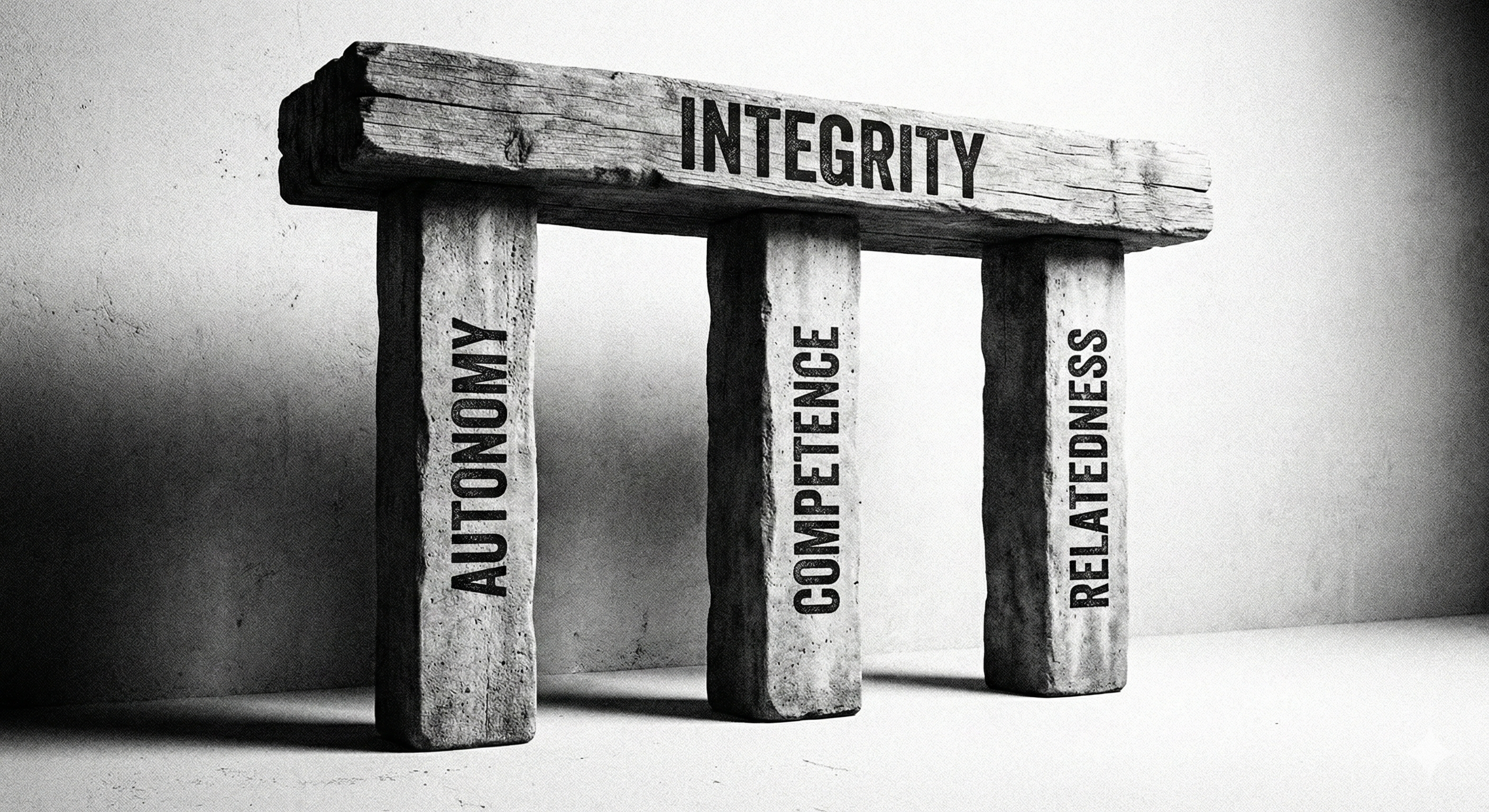
The Architecture of Integrity
The need to be the author of own decisions, not feeling controlled, doing something for the joy
of
it.
The need to feel you are capable of achieving the outcomes you want, that you grow and extend
your
abilities.
The need to belong, interact with, be connected to, and care for others, but also to feel that
others care for you.

Motivation is invisible, psychological needs feel abstract, but performance is something we can all see. To drive that performance, we must translate the hidden science of human needs and what motivates us into a clear framework. We can bridge this gap with The 3 Pillars of Performance:
"Relatedness" or "Belonging" can sound like a social club. What's really an important pillar in organizations are Relationships. High-performing teams run on trust, and that needs a good degree of relation between its memebers. If the relationship breaks, the workflow breaks.
It's not about giving people "freedom", "independence". That sounds like a holiday. But, when people feel they can make their own decision and have access to meaningful choices, well... that shifts their attitude from "waiting for permission" to "solving the problem".
Being compentent is just the baseline. It's not enough to be skilled. Your team needs to feel they are having a real impact. If they work hard but see no result, the burn out. If they don't see the purpose of their work, they'll disengage. Impact is a real differentiator for performance.
After long years of looking at what worked well in working with people and what not, I came to the conclusion that everything boils down to how we run 1:1s. This makes the difference in whether people are motivated and enagaged or not. And here is an easy operational protocol for making the Distance smaller and smaller.
Before the meeting: Check your own "Distance". Are you looking for a solution, or are you looking to be right? Are you looking for the result, or are you looking at the process/journey?
The "Positively Uncomfortable" moment. Put the elephant on the table. Speak the raw truth without aggression. Force yourself to ask one more question.
Not just agreement, but alignment. Define the "Why" (Relatedness) and the "How" (Competence) and the "What" (Autonomy) together.
The hand-off. Provide them with the right delegation level to execute. Step back. Let them own the weight. Show your appreciation for their efforts & skills.
Leadership Trainer
I am not a therapist. I am not a consultant. I am a helping partner for leaders who are tired of excuses and lying to themselves. Who feel the weight of the "Lonely at the top" and stuck.
After almost 2 decades in Tech, Highly Regulated Environments and Leadership, I realized that most business problems aren't about strategy. They are about the lies we ignore.
I built simply untangle because I was tired of watching brilliant teams fail slowly due to polite silence. My work is not to make you feel good, it is to make you sufficiently uncomfortable, so you change. It is to help you see clearly.
If you're up for the task, I am here to expose the lies!